I fell for a crypto giveaway scam. I didn’t almost fall for it. I actually did. On October 15, 2026, I sent a hundred dollars in Bitcoin to a fake Elon Musk on YouTube. I’m writing this so you don’t do the same thing.
I’m 68. I’ve run restaurants, I’ve been around a few con artists, and I write a website about using AI wisely. I still got caught. If it can happen to me, it can happen to anyone who’s excited about the news that night.
What happened
That was the night of the Tesla Roadster reveal. Elon Musk showed the new car at the SpaceX test site in McGregor, Texas. It went off a ramp on cold-gas thrusters, which are small jets of compressed gas, and it landed on its tires. The excitement was real, and I was caught up in it.
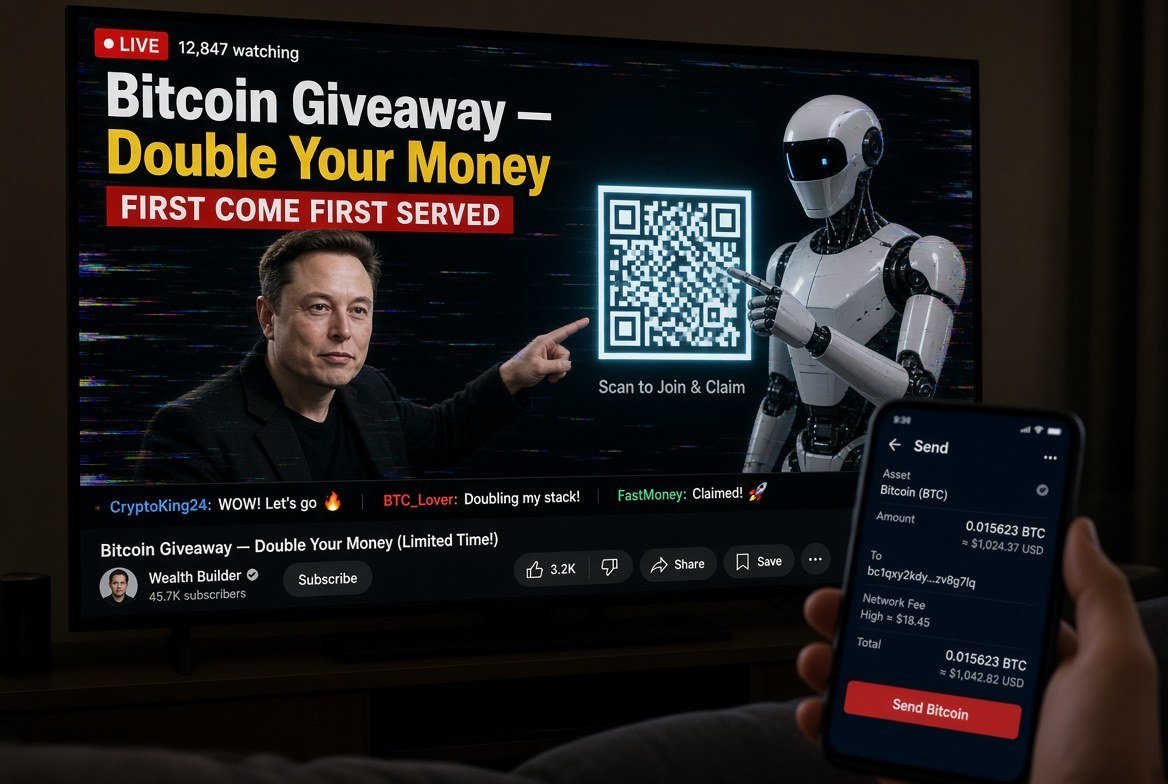
I found a “live” YouTube stream with Musk on screen. There was a giveaway: send Bitcoin, and get double back. Bitcoin is a kind of digital money you send from an app straight to an address, which works like an account number. A QR code was on the screen. That’s the little square barcode your phone camera can read.
The QR code didn’t go to Tesla. It went to a website called roadster[.]tv. That’s a lookalike address, made to sound like it belonged to the real Roadster event. It didn’t. (I’ve broken up the address on purpose so nobody clicks it. Please don’t visit it.) Sites like that often show a scrolling list of “live” payments going out. Those can be made up, or just the scammers moving their own money around, and they’re there to make you hurry and send more.
I sent $100 in Bitcoin. Later I found out the minimum was 0.1 Bitcoin, which is a lot more than $100. I didn’t meet it, so in their eyes I hadn’t even “qualified.” Not that it would have mattered, because nobody was ever going to pay anybody.
Afterward the stream was gone, just disappeared. The next morning I found the video in my YouTube history. It now shows ordinary, legitimate Tesla content, with no Musk giveaway and no QR code. That’s a common pattern with these scams. Someone takes over a real channel for a few hours, runs the fake stream, and then the owner’s content comes back. If you go looking later, the evidence may already be gone. When I told someone I trust what I’d seen, they said right away that it was a scam. They were right.
Something felt off, and I talked myself past it
Looking back, my gut saw it before my brain did. The “Elon” on screen looked almost AI-made. His skin looked a little plastic. His eyes didn’t quite follow anything. The sound ran a beat behind his mouth.
That’s what a deepfake looks like. A deepfake is a fake video made with AI so it looks like a real person is talking. I noticed every one of those things. Then I told myself it was just a bad stream.
A real livestream feels alive. The light changes a little as people move. Faces make small movements, like blinks, shrugs, and glances around the room. The background noise changes. A deepfake tends to look too smooth and too steady. If your gut says something’s off, listen to it.
Crypto giveaway scam red flags
Here’s what I wish I’d had taped to my screen.
- They ask you to send crypto first. Real prizes never require a deposit. If a giveaway wants your money before it gives you anything, it’s a scam. Every time.
- A QR code or wallet address shows up during a “live” event. That isn’t a prize window. It’s where your money goes in and doesn’t come back. Look at the web address before you do anything. A name that sounds official, like the event or the company, doesn’t make it the real site.
- They rush you. Watch for lines like “first come, first serve” or “only during this broadcast.” The hurry is there so you don’t stop to think.
- The channel is new, renamed, or gone the next day. Scammers take over or rent YouTube channels, run the fake stream for a few hours, collect, and shut it down before YouTube catches up.
- The comments are full of people saying they got paid. Those comments come from bots, which are fake accounts run by software. Real people are not lining up to cheer.
- It’s too good, too sudden, and tied to big news. If everyone’s already excited, that excitement is the bait. The hook is working the way it was built to work.
And one more of my own: if the face or voice looks a little off, believe your gut. Plastic skin, eyes that don’t track, and sound that lags behind the mouth are signs of a deepfake.
This isn’t new
This scam has been running since at least 2022. One scam wallet alone took in about $5 million between March 2024 and January 2025. I wasn’t the first, and I won’t be the last. That’s why I’m telling you.
More on this: How to Spot Online Scams with AI and Is That Photo Real?
If it already happened to you
First, stop sending money. Don’t send “one more payment” to unlock the prize. That’s part of the scam too.
Then report it. I filed my report with the FBI the same night. Here’s how.
- Go to ic3.gov and click File a Complaint. IC3 is the FBI’s Internet Crime Complaint Center, the place to report online fraud. Create an account so you can come back and add to your report later.
- Pick the type of fraud. Choose Cryptocurrency Fraud, or Investment Fraud if that fits better.
- Give them the details that matter most. That’s the wallet address you sent the money to, and the transaction hash. A transaction hash, sometimes called a TXID, is a long string of letters and numbers that works like a receipt number for your payment. You’ll find both in your wallet app, or on a block explorer, which is a website that looks up crypto payments. Add the date, the amount, the kind of crypto, and how they reached you. For me, that was a deepfake giveaway on YouTube.
If you’re 60 or older and want help with the form, call the National Elder Fraud Hotline at 833-372-8311. A real person will walk you through it.
Then do two more things:
- Report it to the FTC at reportfraud.ftc.gov.
- Contact the app or exchange where you bought the Bitcoin. An exchange is the company you bought it from. Tell them what happened.
Be realistic about what happens next. The FBI collects these reports and looks for patterns. They don’t investigate every case, and they can’t promise to get your money back. I filed anyway, because every report helps them see the bigger picture.
Watch out for “recovery” offers. If someone contacts you later offering to get your money back for a fee, that’s usually a second scam. They know you already lost money once.
And tell somebody. I almost didn’t. Saying it out loud is how I found out what really happened.
How AI can help, and how it can’t
The fake Elon was made with AI. AI can also help you on the other side. Before you send money to anything you saw online, paste the offer into Grok, Copilot, Gemini, or Claude and ask:
I saw this offer online: [paste or describe it]. Does this match any known scam? List the red flags. Don't tell me it's safe unless you're sure.It’s a second opinion, not a guarantee. The checklist above still comes first.
The lesson I paid $100 for
A hundred dollars stings. But it’s cheap compared with what other people have lost, and it bought me a lesson I’m passing on to you for free. Real giveaways don’t ask you to pay first.
Has something like this happened to you, or nearly? Tell me in the comments. No judgment here. I’ve been there.
— Andrew
Sources
I want you to be able to check what I wrote, so here’s where the facts came from.
- Where the $5 million figure comes from: https://tabiji.ai/scams/everywhere/celebrity-impersonation-crypto/
- What happened at the real Roadster reveal (Reuters, via KSL.com): https://www.ksl.com/article/51636671/tesla-set-to-unveil-next-generation-roadster-sports-ev-after-years-of-delay
- The thruster launch and landing (Austin American-Statesman live blog): https://www.statesman.com/business/article/tesla-roadster-event-live-texas-mcgregor-22433111.php
- How the fake Musk giveaways on YouTube work: https://cybernews.com/news/youtube-deepfake-musk-crypto-giveaways-resurface/
About the author: Andrew is a 68-year-old former restaurant professional who writes Simple AI Stuff for regular people learning AI. He’s learning it with you, mistakes included.
Want more plain-English AI help? Get my free 9-page starter guide.
The guide arrives in your welcome email right after you confirm.