There’s so much junk out there about UFOs. So when a video showed up on X with the caption “We are not alone in the universe. A new name has risen ‘octopus UFO’… It reminds me of Arrival aliens,” I figured I knew how this one ended. Here we go, I thought, it’s another hoax.
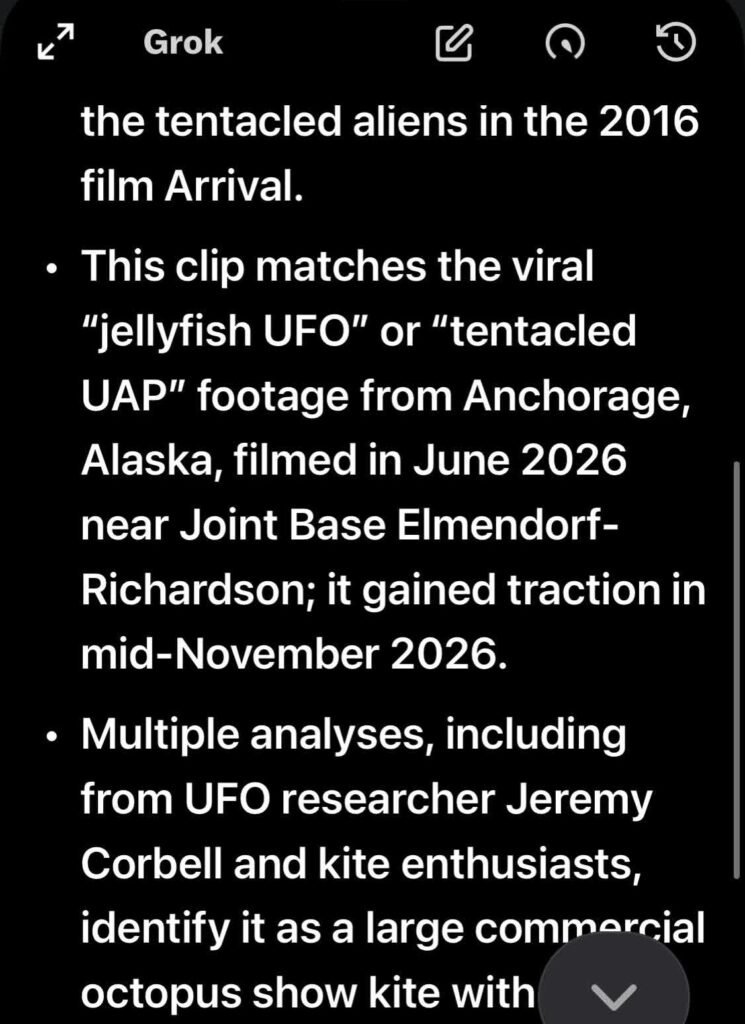
I didn’t even have to type a question. Under the post, X showed a Grok summary (Grok is the AI assistant built into X). I opened it. Grok said this clip was the viral “jellyfish UFO” footage from Anchorage, Alaska, filmed in June 2026, and that kite fliers and researchers identify it as an octopus show kite.
I’ll be honest, I was surprised. Hearing it’s a kite, I looked at it really close. I was surprised to hear it was credible, real video footage. Who knows what it is? But wow.
That’s the lesson I keep relearning. A video can be real and still come with the wrong story attached.
What the Anchorage video actually is
Here’s what I found once I followed Grok’s summary back to the news stories:
- It’s real, and it’s old. A woman in East Anchorage filmed it on her phone on June 15, 2026, around 10 at night (it’s still light that late in an Alaska June). She was filming a rainbow when she noticed it and posted it to Facebook. It sat there for months.
- It went viral months later. In early November, a UFO account on Instagram reposted it with its own headline. Within a week it was on news sites around the world.
- It’s most likely a kite. Kite fliers who looked at it say the shape and the waving arms look like an octopus show kite. Those are big, soft kites with long fabric tentacles, some up to about 100 feet. A local kite club lists a park close to where she was filming as one of its flying spots. The former head of the Pentagon’s UFO office said the motion “is similar to a kite with streamers.” But nobody has come forward with a kite. The woman who filmed it says it didn’t move like a kite, and she found no one flying one afterward. So “most likely a kite” is the honest answer, not “definitely a kite.”
- The “over a military base” part doesn’t hold up. Lots of reposts said it was over Joint Base Elmendorf-Richardson. A local news site worked out from the rainbow and the sun that she was facing away from the base’s airfield, toward the mountains. The base said it knows about the video but had nothing more to say.
Here’s the part that got me. Grok’s own summary said the clip was filmed “near Joint Base Elmendorf-Richardson.” That’s the same military-base angle the reporting doesn’t back up. So even the AI repeated part of the wrong story. It got the big things right, but it picked up the spin along with the facts.

As the clip traveled, people added “enhanced” stills, narration, and “secret military technology” talk. None of that is in her original video. That’s the “wrong story” part.
My checklist before I believe a viral video
I’ve written before about checking photos (Is That Photo Real?). Videos need a few more steps, because the footage can be real while the story around it is made up.
- Ask the AI right there. On X, tap the Grok button under the post, or open the Grok summary if one shows up. Don’t stop at “is it fake?” Ask where it came from, too. Other AI tools work if you paste in the link or a description.
- Find the original post and the date. Who filmed it first, and when? This one was filmed in June and went viral in November. A five-month-old video sold as “breaking news” is a red flag.
- Check whether the caption matches what you see. The caption said “over a military base.” The video shows a rainbow, a mountain, and a strange shape. Ask yourself: does the video actually show what the words claim?
- See what named people say. Look for real people with real names and jobs, like a former government investigator or a reporter who checked the weather records. “Experts say” with no names doesn’t count.
- Be okay with “we don’t know.” Sometimes the honest answer is “probably a kite, not confirmed.” I’ve decided I can live with that. It beats believing the wildest version just because it’s the most fun.
A prompt you can copy and paste
Next time a wild video stops your scrolling, try this with Grok, Copilot, Gemini, or Claude:
I just saw this video: [paste the link or describe it]. Please tell me: Is it real footage or made with AI? Where and when was it first posted, and by whom? Does the caption match what the video shows? What do named experts or news outlets say it is? Tell me plainly what is confirmed and what is still unknown.That last line matters. It asks the AI to separate what’s known from what’s guessed.
Where I wouldn’t use AI
Grok can tell me where a video came from and what the experts say, but it wasn’t there. I don’t treat its answer as the final word. This time it even repeated the military-base angle the reporting doesn’t back up. It’s my starting point for checking.
What I’m taking from this
I went in sure it was a hoax and came out knowing it was real video with a made-up story wrapped around it. That’s a better place to be. I don’t have to know what everything is. I just have to slow down long enough to check before I hit share.
Sources
- Alaska News, “Anchorage’s viral ‘jellyfish UFO’ was filmed in June, and it may be a kite” (Nov 13, 2026): https://alaskanews.com/c/alaska-news/anchorages-viral-jellyfish-ufo-was-filmed-in-june-and-it-may-be-a-kite
- Fox News, the former Pentagon UFO investigator’s take (Nov 14, 2026): https://www.foxnews.com/us/pentagons-former-ufo-investigator-offers-simple-theory-mysterious-jellyfish-shaped-object-video
- UAP Codex, case page for the Anchorage video: https://uapcodex.org/cases/anchorage-jellyfish-2026/
- Metabunk forum discussion of the octopus kite idea: https://www.metabunk.org/threads/anchorage-alaska-%E2%80%94-november-4-2026-%E2%80%94-octopus-kite.15178/
I write these with help from Grok and Grok Bot, my AI assistants. The experiences and opinions are mine, and I check the facts before publishing.
Want more plain-English AI help? Get my free 9-page starter guide.
You can download it right after you confirm your email.