Medicare explained simply. That is all I wanted when the 2027 Medicare & You handbook landed on my table.
I’m 68. I’m still working. I have read restaurant contracts, vendor invoices, and health inspection reports for decades. And this booklet still made my eyes glaze over by page 83.
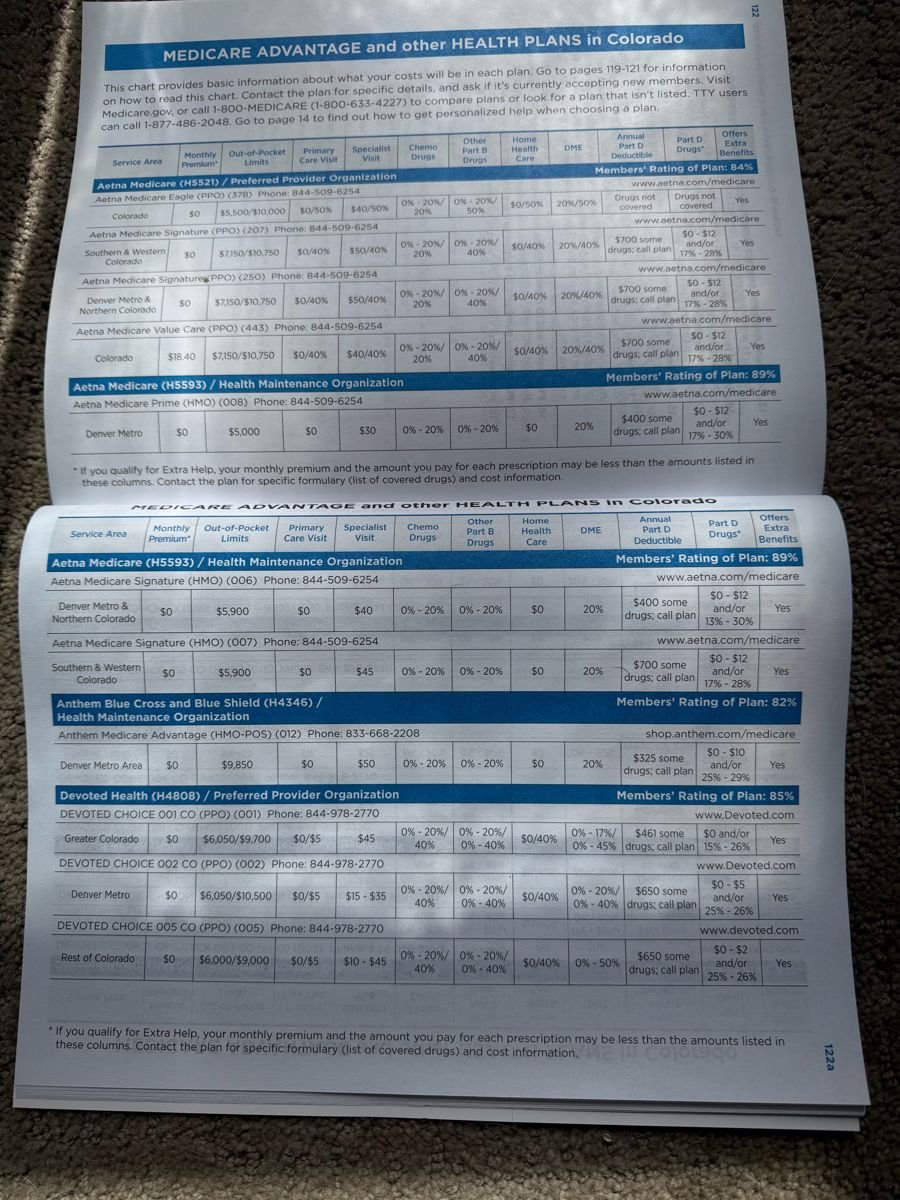
Then I got to the plan chart. Tiny boxes. Columns for premiums, out-of-pocket limits, specialist visits, drug deductibles, “0% – 20%,” “$0/40%.” Every fall I look at that grid and have the same thought: I wish someone was sitting next to me saying, “Here’s what you actually need to decide. One step at a time.”
So I made someone sit next to me.
Numbers in this post come from the 2027 Medicare & You handbook, photographed in September 2026. Medicare numbers change every year, so check the current year before you rely on any of them.
What I did
I laid the booklet flat by the window and took photos of the pages that confused me: the drug coverage section (Part D) and the Colorado plan chart. Then I opened Grok, attached the photos, and typed this:
Take a look at these images. Review the entire 2027 Medicare program and put it in steps, one by one, so I can easily understand and digest it and make wise decisions that fit my lifestyle. Here's roughly how much I make a year: [amount]. Here's my monthly Social Security: [amount]. Here are the prescriptions I take: [list]. I live in [area]. If you need anything else from me, just ask. Don't recommend a specific plan. Tell me what to double-check with Medicare.
That last part matters. I don’t want a tool picking my plan. I want it to clear the fog so I can pick.
What I gave it, and what I didn’t
Income matters here, because people with higher incomes pay extra for drug coverage. So I gave it round numbers.
I did not give it my Social Security number, my Medicare number, bank information, or anything off a card in my wallet. It doesn’t need them to explain a booklet. Nobody explaining a booklet does.
Medicare explained simply, step by step (shortened)
Here is the kind of answer I got. I trimmed it, but this is the shape of it:
Step 1. Mark your window. Open Enrollment runs October 15 to December 7. That is when you can switch plans for next year. If you still have health coverage through work, call your benefits office before you change anything. The handbook warns that signing up for other coverage could cost you your work coverage.
Step 2. Pick your road. There are two ways to get drug coverage. Road one: Original Medicare plus a separate drug plan (Part D). Road two: a Medicare Advantage plan that includes drugs. Everything else depends on this choice.
Step 3. Make your list before you look at any chart. Write down every prescription and every doctor you want to keep. A plan that looks cheap is not cheap if it doesn’t cover your drugs or your doctor isn’t in it.
Step 4. Know the 2027 guardrails. Your out-of-pocket cost for covered drugs is capped at $2,400 for the year. Once you hit that, you pay $0 for covered drugs for the rest of the year. A plan’s drug deductible can’t be more than $700.
Step 5. Check the income line. The extra charge for higher incomes (the handbook calls it IRMAA) applies above $111,000 if you file alone, or $222,000 if you’re married and file jointly. Based on the numbers you gave me, here’s whether that likely applies to you. Confirm with Social Security.
Step 6. Don’t leave a gap. If you go 63 days or more in a row without drug coverage that counts, you can owe a late enrollment penalty. It gets added to your premium for as long as you have Medicare drug coverage.
Step 7. Ask about help. Extra Help can lower drug costs if your income is limited. There’s also a payment plan that spreads your drug costs across the year. It doesn’t lower the total. It just evens out the bills.
Step 8. Compare two or three plans, then decide. Put your drug list into the Medicare Plan Finder. Call 1-800-MEDICARE, or get free one-on-one help from your State Health Insurance Assistance Program (SHIP).
Questions for you: Which pharmacy do you use? Do you travel out of state for long stretches? Is there a specialist you see often?
That last part surprised me. It asked me questions back, the way a good server asks, “Any allergies?” before recommending a dish.
What it still can’t do
I trust this for the fog. I don’t trust it for the final call.
It can misread a chart. Those boxes are tiny. A “$40” can become a “$4” in a blurry photo. Check any number that matters against Medicare.gov.
It doesn’t know your pharmacy’s prices. Plan Finder does, when you enter your drugs.
It can’t enroll you, and it shouldn’t pick for you. It can hand you better questions. You still call, compare, and decide.
Next year’s numbers will be different. That’s why every photo in this post has a date on it. If you’re reading this in 2028, get the new booklet and run the prompt again.
If you want more on where AI helps and where it doesn’t, I wrote AI Explained Simply: What It Can Do Today (and What It Still Can’t).
Why this is what AI is good at
This is what I keep coming back to. AI is at its best when you’re drowning in fine print and just need someone to read it with you. Not decide for you. Read it with you, in plain English, one step at a time.
Medicare. An insurance letter. A lease. A hospital bill with codes you’ve never seen. Same move every time: take a photo, ask in plain English, tell it what you need, and ask it to ask you questions. Then you make the call.
If you’re new to all this, start with How to Start Using AI Without Feeling Overwhelmed.
Free guide (no jargon)
If you want a short starter you can keep, grab my free 9-page guide on Simple AI Stuff. Same voice as this site. No hype.
Your handbook is probably on the table right now. Pick one page that bugs you. Try the prompt. Tell me in the comments what it cleared up, or what it got wrong. I read every one.
This is not financial or medical advice. It’s how I read my own handbook. Confirm your choices with Medicare or a SHIP counselor.
— Andrew