I grew up in McHenry, Illinois, and graduated in ’76. My dad always planned our trips ahead with paper maps.
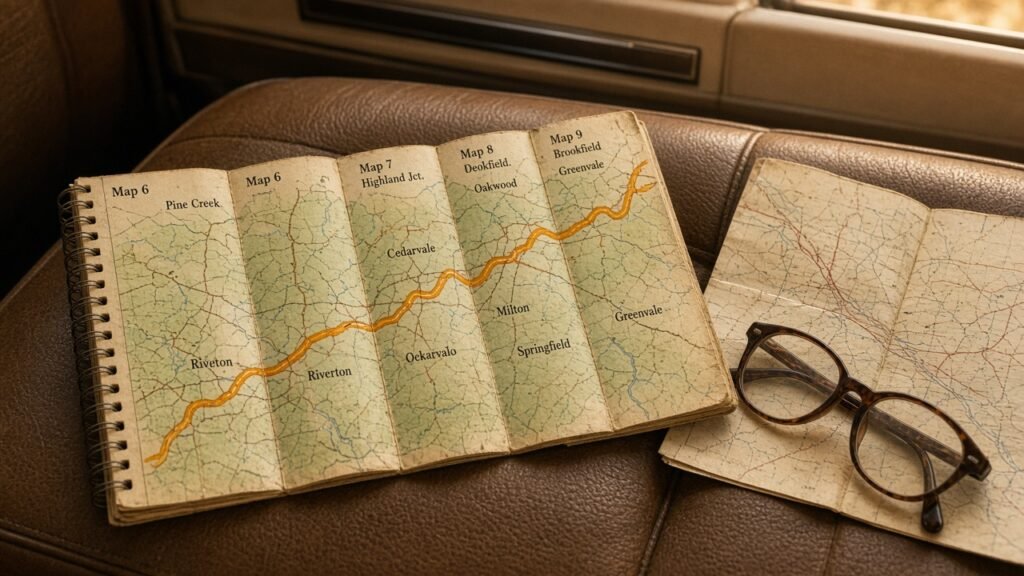
My late dad even bought me a Chicago Motor Club membership so I could order maps and TripTiks. A TripTik was AAA’s flip-page strip map with your route highlighted.
I used a TripTik myself to drive from Chicago to Arizona. It was like having navigation in your hand. Turn to the next page, now you gotta go here. It was an analog version of digital navigation.
There was no digital photography back then, either. You took your film to the camera shop or a photo studio (drugstores didn’t develop it) and waited, so taking pictures was a deliberate thing you did mostly at family events. That’s why I have very few photos of my dad from that era.
Today the car tells you where to turn. I can just picture my dad sitting behind the wheel with navigation talking to him: “Are you kidding me? It’s telling me which way to turn. This is nuts.”
Some hardliners still refuse to use navigation. But I keep wondering what planning with AI would have meant for my dad.
My dad did it all by hand
My grandfather bought a bakery in Chicago and kept the name, Sarno’s Pastry Shop. My dad married the baker’s daughter, took over the business, and worked it. When the city built the Chicago Circle Campus, the bakery had to go. We were building a vacation home in McHenry, so we moved there.
In McHenry, we ran restaurants. When we relocated, my dad bought a place called Lenny’s Snack Shop on Green Street and renamed it Jim’s Snack Shop, after himself. If you remember Happy Days, it was sort of like Arnold’s: a tufted stainless steel back wall, a grill, an old-school fountain for the sodas, a cash register with the big buttons, and a countertop with stools. It even had a phone booth and a jukebox. It was pretty cool. After Jim’s came Dorky’s, then Selvaggio’s Indian Manor. My dad did everything by hand: labor, food costs, the back office, inventory, analysis, and taxes.
When he needed an answer, he often had to go see someone in an office. Or he learned it the hard way.
I get emotional when I imagine the tools he could have had. So last night, I tried something.
What I tried, and what happened
I asked Grok to plan the Saturday my dad would have taken us on. Grok is an AI assistant, a program you can ask questions. It would be my dad, my mom, my brother, and me, in Dad’s Oldsmobile Toronado.
Here’s the day:
- Lunch at Gene & Jude’s
- Johnnie’s Beef
- Ferrara Bakery on Taylor Street
- A frozen custard surprise on the way home
- Maybe a quick visit to Grandma in Des Plaines
- Home by dark
Grok built a timeline and suggested what to order: a Depression Dog at Gene & Jude’s, Italian beef or the beef-and-sausage combo at Johnnie’s, and cannoli at Ferrara.
For custard, one of Grok’s ideas was Polar Bear, “a classic old-school stand,” and it said to call ahead because hours vary. Polar Bear is where our family really went when I was a kid. My dad got us dipped cones and banana splits.
Then Grok said the Toronado had room in the trunk for pastry boxes.

I felt immediately that I missed my father. I pictured us all going together, and I got choked up. The whole moment came alive for me.
Here’s the twist. I’m the one who put Ferrara on the list. But back in the Sarno’s days, Ferrara was a competitor. We also went to Albano Bakery, where the baker had been my dad’s “apprentice.”
I loved that pastry-box line, because you’d never go to the bakery without taking something home. As a kid, I was in the back of our bakery with the wooden tables and all the little cannoli shells. I don’t think Dad would have let Grok pick the bakery. He’d likely have steered us to his own place, or to his former apprentice’s. I can just hear him:
“Grok doesn’t know. We’re gonna get this one. This is what you wanna buy.”
The Toronado didn’t have GPS, and my dad knew those roads by heart, so I also asked Grok for directions the old way.
Some turns were wrong. Grok called Route 120 “Rand Road,” but out of McHenry, Route 120 is Belvidere Road. Rand Road is a different road.
If Grok had told my dad to go that way, I can hear him now:
“Grok is stunad, don’t be a strunz.”
That’s Italian-American slang. Stunad means a dummy, and strunz means a jerk.
So check the directions yourself.
The seawall my dad fought with
When I was in about fourth or fifth grade, our house sat on a T-shaped channel off the river. We had what we called a seawall. It was corrugated metal driven into the riverbed, backfilled, with a concrete sidewalk around the edge of the lot.
It started falling in. The guy who fixed it was an engineer and a welder who looked like Thor. He didn’t do it right, and it failed again. My dad was really aggravated.
Back then, Dad just had the one guy he knew. It was a small town, and nobody came in from the city. There was no internet and no email. You called someone up. If they were there, they were there. If they weren’t, you kept calling.
That made it really hard to round up several people for bids. Sometimes you had to go see them in person.
What he could do today
Now picture my dad photographing the wall and asking AI to act as a structural, marine, and welding expert.
Where did they go wrong? What’s the best design? How do we make sure this never happens again? Can we add a boat pier? What materials, what costs, what hourly rates, what timeline? He had about $1,000 back then. What should he ask each of three bidders? And what did he miss?
Then he gets three solid quotes and fixes it right, once and for all.
Got a repair of your own? Copy this prompt, attach your photos, and fill in the brackets.
I'm attaching photos of [what needs fixing, like my seawall or porch].
Please act as an experienced [structural, marine, and welding] expert.

1. What might have gone wrong? What can't you tell from a picture?
2. What are the best ways to fix it, and how do I keep it from
   happening again?
3. Can I add [an add-on, like a boat pier] at the same time?
4. What materials, rough costs, hourly rates, and timeline should I
   expect? My budget is [your budget].
5. I want three quotes. What should I ask each bidder?
6. What permits should I ask my town about?
7. What am I missing?
Treat the answers as a starting point; real numbers come from people who see the job.
Where I wouldn’t use AI
AI can plan the day, but call ahead to check the hours and double-check the directions on a map. For a repair like a seawall, AI helps you ask better questions and compare bids, but a licensed engineer and your local permits still make the call.
What this means to me
This post puts things in perspective for me: gratitude for how things progress, and how we take for granted that technology, whether we like it or not, makes things a little easier.
AI is an empowerment tool. It enables us to do things we couldn’t do before. Not that we aren’t smart enough, it’s just that we aren’t able to do it. In some instances, of course, we’re not smart enough, and that’s why we need AI to educate us. And that’s okay.
We’re human, and we’re working with a fantastic tool that’s going to help us become better.
My dad planned with paper maps, kept our McHenry restaurants’ books by hand, and fought that seawall with a telephone and the one guy he knew. I think he’d have liked this kind of help. And he’d still pick the pastries himself.
New to all this? Start with AI Explained Simply: what it can and can’t do.
Sources
- Wikipedia, Illinois Route 120, showing it is Belvidere Road and crosses U.S. Route 12 (Rand Road): https://en.wikipedia.org/wiki/Illinois_Route_120
I write these with help from Grok and Grok Bot, my AI assistants. The experiences and opinions are mine, and I check the facts before publishing.
Want more plain-English AI help? Get my free 9-page starter guide.
You can download it right after you confirm your email.