If you want the short version: Posts that say an AI trading bot made someone rich overnight are almost never real. There’s usually no proof, and the flashy win is there to get your attention — and often your money.
A quick note before we go further: if words like AI, bot, crypto, or Solana feel unfamiliar, you’re not alone. For many of you these are odd terms. I’ll keep them plain as we go, and there’s a short glossary near the end you can flip to anytime.
Here’s what we learned
- Overnight “AI made me rich” posts almost never show real proof of the trades.
- The same “fund it and go to sleep” story often repeats with new numbers. It’s usually about growing an account, then steering you into a chat group, a paid course, or a referral link.
- Treat these as red flags: no wallet or public record, identical overnight-win videos, “paste this prompt and sleep,” a Discord or Telegram pitch at the end, and big or guaranteed returns.
- AI is useful for checking a claim and explaining terms. It can’t predict the market, print overnight profits, or safely hold the keys to your money.
- If you already sent money, don’t send more to “get it back.” Report it to the FTC and the FBI, and tell someone you trust.
- Before you believe a post like this, paste it into Grok, Copilot, Gemini, Claude, or whatever you use and ask, “Is this legit?” Then look for the proof.
You can stop here if that’s enough. Want the story, the checklist, and the backup? Keep reading.
The story
The other day a post on X caught my eye. Someone said they gave an AI system $150 before bed and woke up to $1,280.
The post had a slick video of a dashboard, which is a screen full of charts and numbers. It had a long “prompt” you could copy. A prompt is just the instructions you type into an AI. The message was simple: set this up, go to sleep, and wake up richer.
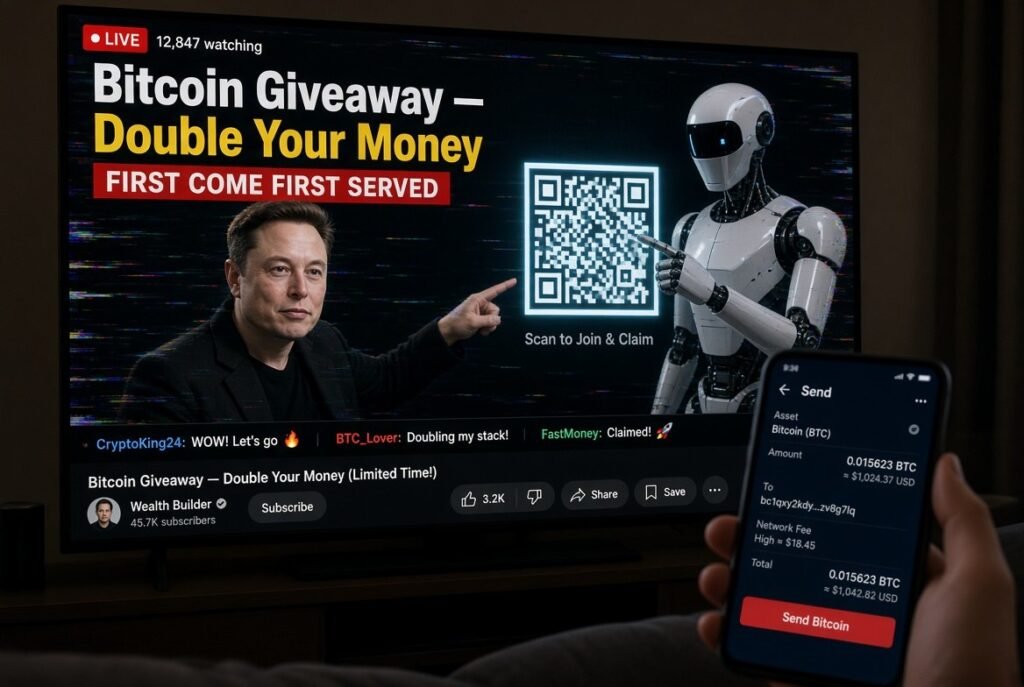
I’ve been burned before. Last month I sent $100 to a fake Elon Musk giveaway during the Tesla Roadster reveal. I wrote about it here: I Sent $100 to a Fake Elon Musk Giveaway. So this time, before I believed anything, I asked Grok.
When I first saw that post — and a lot of posts like it — I was thinking I could really use some extra money to turbocharge things as I get closer to retirement. Wouldn’t it be amazing if this actually worked? I got excited, and that excitement is what drew me in.
What the post claimed
The post came from a newer account on X. It said a “Grok Bot” setup, a team of AI helpers working together, traded Solana memecoins overnight. Memecoins are joke cryptocurrencies. New ones pop up constantly, and most of them go to zero. Solana is one of the networks they trade on.
According to the post, the AI scanned more than 10,000 coins, made 38 trades, won 26 of them, and turned $150 into $1,280 by morning.
That’s the claim. Here’s what Grok found when I asked if it was legit.
What Grok told me
Grok’s answer started with one word: no. It said this isn’t a verified real-money result. Here’s why, in plain terms:
- No proof. There was no wallet address or public record of the trades. A crypto wallet is the account that holds your coins. Every real trade on Solana leaves a public record anyone can look up. If you really made that money, it’s easy to prove. They didn’t.
- The same story, over and over. Grok said the same account had posted a string of nearly identical “fund it and go to sleep” wins, with different starting amounts and different totals. Same formula, new numbers.
- The video isn't proof either. A polished dashboard can be made to show anything. Grok said the deposit screen in the video looked like a made-up screen, not a real transaction.
- It's too good, too often. Grok said winning that big and that consistently on brand-new memecoins is lottery-level luck, not a system you can repeat.
Then I asked Grok what the person gets out of it. I typed, “There are so many posts like this, plus get rich with prompts. People think that AI, Grok, can do trading. It’s a honey trap. What is the person who posts’ motivation?”
Grok said it’s mostly about attention. Posts like this get saved and shared by thousands of people, which grows the account. The next step is often a sign-up for a chat group on Discord or Telegram (two popular group-chat apps), a link to a trading app that pays the poster a referral fee, or a paid course or “managed bot.” The overnight win is the advertisement.
Why this one worries me for our age group
I said this to Grok, and I’ll say it here: “For seniors this could cause trouble, like when I got taken with the Tesla Roadster crypto scam.”
These posts don’t look like the old scams. There’s no Nigerian prince and no one asking for your bank password. They look smart and technical, with charts, rules, and safety settings. That’s exactly why they lower your guard.
Grok also said the people calling these posts fake are usually buried in the replies, while the original post gets the attention. I don’t want anyone’s free speech shut down. But I don’t want my readers learning from the replies after their money’s already gone.
The AI trading bot scam red-flag checklist.
If you see a post about AI making money while someone sleeps, check for these:
- No wallet, no proof. If someone claims crypto profits and won’t show the public record of the trades, treat the numbers as marketing.
- Identical "overnight win" videos. The same kind of dashboard video, the same story, just with new numbers each time.
- "Paste this prompt and go to sleep." No set of instructions turns an AI into a money machine.
- A funnel at the end. “Join my Discord,” “DM me on Telegram,” “link in bio,” “buy my course.” That’s where the real money changes hands, and it’s yours going to them.
- Big, fast, or guaranteed returns. The CFTC, the U.S. agency that oversees futures and commodity trading, says claims of high or guaranteed returns are red flags of fraud.
If you see two or more of these, scroll on.
What AI can and can’t do with your money
I want to be fair here, because I use AI every day.
What AI can do:
- Explain a money term in plain English, like what a memecoin or a stop-loss is.
- Help you check a claim, the way Grok checked this one for me.
- Help you write down questions to bring to my financial advisor, or to yours.
- Walk you through the risks of something before you put a dime in.
What AI can't do:
- Predict the market. The CFTC says it plainly: “AI technology can’t predict the future or sudden market changes.”
- Print guaranteed overnight profits. Nobody can, AI or not.
- Safely hold the keys to your money. In crypto, your “keys” are the secret codes that control your wallet. Whoever has them has your money.
- Be trusted to place real trades on its own while you sleep. Some tools can be hooked up to place trades. That doesn’t mean they’ll make money, and it does mean they can lose it fast.
FINRA, the SEC, and state regulators put out a joint warning about this too. They say AI-generated information “can be faulty, or even completely made up,” and they suggest checking with a registered investment professional.
Where I wouldn’t use AI
I won’t let any AI place live trades for me or hold the keys to my money. Not Grok, not anything else. I use it to ask questions, not to hand it my wallet.
If you already sent money
Don’t send more to “get it back.” That’s often the second half of the same scam. Report it to the FTC at ReportFraud.ftc.gov and to the FBI at ic3.gov. Then tell someone you trust. I did, and it helped. My fake giveaway post has more on what to do next.
The lesson
I lost $100 learning that if something online promises easy money fast, it’s selling something. The only difference now is that the pitch comes with an AI sticker on it.
Before you believe a post like this, do what I did. Paste it into Grok, Copilot, Gemini, Claude, or whatever you use, and ask, “Is this legit?” Then look for the proof. If there isn’t any, you have your answer.
For more on checking things you see online, see How to Spot Online Scams With AI.
I’m learning right alongside you.
A few terms, in plain English
If any of these showed up above and you’re still unsure, here’s what I mean:
- AI — Short for artificial intelligence. Computer software that can answer questions, write, or analyze things in a way that feels a bit like talking to a person. Grok, Copilot, Gemini, and Claude are examples.
- Bot — A program that does a task for you, often automatically. An “AI trading bot” is software that claims to buy and sell investments on its own.
- Trading — Buying and selling things that can go up or down in price, like stocks or crypto, hoping to make a profit.
- Crypto / cryptocurrency — Digital money that exists on the internet, not as cash in a bank. Bitcoin is the best-known example. Values can swing wildly.
- Solana — One of the networks (think of it as a digital highway) where people buy and sell certain cryptocurrencies.
- Memecoin — A joke cryptocurrency, often named after a meme or trend. Most of them end up worthless.
- Giveaway — In these scams, a fake contest that says a famous person will send you money or crypto if you send a little first. You don’t get anything back.
- Prompt — The instructions you type into an AI, like asking it a question or telling it what to write.
- Wallet (crypto wallet) — The digital account that holds your cryptocurrency. It’s not a leather wallet; it’s more like a locked online account.
- Keys — The secret codes that unlock a crypto wallet. Whoever has them controls the money.
- X — The social network formerly called Twitter.
- Discord / Telegram — Popular group-chat apps. Scammers often push you into a private group there after the flashy post.
- FTC — The Federal Trade Commission, a U.S. agency that helps people report scams and fraud.
- FBI — The Federal Bureau of Investigation. Their site ic3.gov is where you report online crime.
- CFTC — The Commodity Futures Trading Commission, a U.S. agency that oversees certain kinds of trading and warns about investment fraud.
Sources
- The CFTC’s warning, “AI Won’t Turn Trading Bots into Money Machines” (press release with the full advisory): https://www.cftc.gov/PressRoom/PressReleases/8854-24
- The FINRA, SEC, and NASAA joint warning on AI and investment fraud: https://www.finra.org/investors/insights/artificial-intelligence-and-investment-fraud
- Report fraud to the Federal Trade Commission: https://reportfraud.ftc.gov/
- Report online crime to the FBI: https://www.ic3.gov/
- My earlier post on the fake Elon Musk giveaway: https://simpleaistuff.com/crypto-giveaway-scam/
I write these with help from Grok and Grok Bot, my AI assistants. The experiences and opinions are mine, and I check the facts before publishing.
Want more plain-English AI help? Get my free 9-page starter guide.
You can download it right after you confirm your email.